Leave Your Message

Top 10 Types of Compressed Gas for Industrial Use

Compressed Gas supports work across manufacturing, metal fabrication, healthcare, food processing, and water treatment. Yet the term covers more than gases stored in simple cylinders. Some products are compressed, liquefied under pressure, or dissolved in a carrier. That distinction affects storage, handling, and equipment selection.

The International Energy Agency’s Global Hydrogen Review 2024 reports that worldwide hydrogen demand reached about 97 million tonnes in 2023. Most demand came from established industrial uses, including refining and chemical production. The U.S. Department of Energy’s U.S. National Clean Hydrogen Strategy and Roadmap (2023) likewise describes hydrogen as an important feedstock for industry. These reports show why gas selection matters: a material’s purity, pressure, and behavior can influence both process quality and workplace risk.

The ten types discussed here include oxygen, nitrogen, argon, carbon dioxide, hydrogen, helium, acetylene, propane, nitrous oxide, and compressed air. They are not interchangeable. A welding shop may need shielding gas, while a food facility may require controlled carbon dioxide or nitrogen. Small differences matter. Before choosing a gas, teams should confirm application requirements, supplier specifications, compatible equipment, and current safety guidance. This overview is a starting point, not a substitute for site-specific review. Industrial practice can vary, and a neat “top ten” list cannot capture every operational detail.
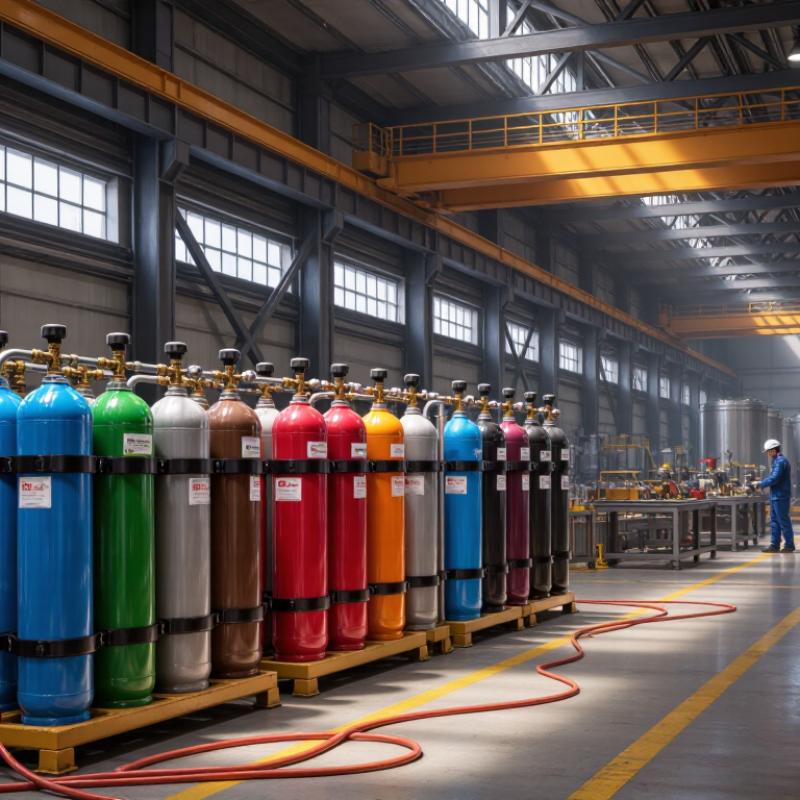
Top 10 Types of Compressed Gas for Industrial Use

Industrial Compressed Gases: Forms, Properties, and Supply

Industrial compressed gases arrive in cylinders, tube trailers, cryogenic liquid tanks, pipelines, or through on-site generation. The right form depends on usage, purity, flow rate, and how often deliveries can reach the site. Cylinders suit smaller or mobile operations, while bulk tanks support steady, high-volume demand. On-site nitrogen generation can reduce deliveries, but requires equipment checks and suitable feed air.

Properties shape how each gas is handled. Oxygen supports combustion, nitrogen is commonly used as an inert gas, and argon protects weld areas from air. Carbon dioxide is supplied for processes such as welding and cooling. Hydrogen is very light, so system design must account for leakage risks. Pressure changes everything. Gas may be stored under pressure or as a refrigerated liquid, and these forms require different equipment. Labels matter.

At a plant, supply reliability is more than having a full cylinder nearby. Staff need to know the gas identity, connection type, pressure requirements, and storage conditions. Keep incompatible gases separated according to current safety guidance, and check regulators, hoses, and ventilation routinely. One detail is easy to overlook: demand can vary sharply between shifts. A delivery plan based only on monthly averages may leave a production line short. Actual consumption records help, though they are not perfect; maintenance work and seasonal changes can distort them. Verify specifications with the supplier and site safety team before changing a gas or supply method.

How to Select a Compressed Gas for Industrial Processes

Choosing a compressed gas starts with the process, not a catalogue ranking. Match gas chemistry to the job: nitrogen can provide an inert purge, while argon is common for welding shields. Oxygen supports combustion, so its compatibility and handling need careful review. Specify purity, delivery pressure, peak flow, moisture limits, and contact materials. I still find one detail easy to miss: a suitable gas can pick up moisture in a long, cold line.

The U.S. Department of Energy’s Improving Compressed Air System Performance sourcebook estimates that compressed-air systems use about 10% of U.S. manufacturing electricity. Some plants reach 30%. The sourcebook also reports that leaks may waste 20–30% of compressor output. These figures make demand profiling and leak checks part of gas selection, not an afterthought.

For compressed air quality, ISO 8573-1 classifies contaminants by particles, water, and oil; specify the required class and verify it with test results. Confirm cylinder or bulk-supply pressure against the equipment’s actual operating range.

Tips: List normal and peak flow before requesting a supply. Check ventilation, compatible seals, and gas detection needs. Ask for a certificate of analysis when purity matters. Keep the specification practical; tighter purity than the process needs can add cost.

Ten Common Types of Compressed Gas Used in Industry

Industrial compressed gases do more than fill cylinders; they control flames, atmospheres, cooling, and process chemistry. Oxygen supports cutting and combustion, while acetylene supplies a hot, focused welding flame. Nitrogen purges tanks and limits oxidation; argon shields weld pools. Carbon dioxide serves welding and beverage carbonation, while compressed air drives tools and actuators. Pressure matters.

Hydrogen is used in refining and chemical manufacture. The IEA’s Global Hydrogen Review 2024 estimates global demand reached 97 million tonnes in 2023, largely in refining and chemicals. Helium helps locate tiny leaks and cool specialized equipment. USGS estimated global helium production at about 170 million cubic metres in 2023 in Mineral Commodity Summaries 2024. Propane provides process heat, while ammonia serves large refrigeration systems. Not interchangeable.

That list is practical, not perfect: gas selection depends on purity, pressure, temperature, regulator compatibility, and ventilation. At a fabrication bay, argon shielding can protect a bright weld, but a poorly secured cylinder creates serious handling risks. Ammonia requires leak detection and trained response. Check the gas specification and current safety data sheet before connecting equipment; labels alone do not establish purity.

Industrial Applications of the Ten Major Compressed Gases

Industrial gas selection starts with the job, not the cylinder. Oxygen supports steelmaking, metal cutting, and wastewater treatment, where controlled oxygen supply can improve process performance. Nitrogen provides an inert atmosphere for food packaging, tank blanketing, and heat treatment. Argon shields welds from air, helping protect the molten metal. Carbon dioxide is used in beverage carbonation, welding, and pH control in water treatment. Small changes in purity can matter.

Hydrogen serves as a chemical feedstock and reducing gas in refining and materials production. Helium helps detect leaks and cool specialized equipment, while compressed air powers tools and supports instrumentation. Acetylene provides a hot flame for metal cutting and repair. Propane fuels industrial heating, drying, and some process burners. The fit is not always neat. A gas useful in one process may be unsuitable for another.

Ammonia is widely used in industrial refrigeration and fertilizer production, but it requires careful leak detection and ventilation because it is toxic and irritating. These gases differ in pressure, temperature behavior, and hazards. Operators should check the gas specification, regulator compatibility, storage conditions, and site procedures before use. Labels and connections deserve attention. A rushed cylinder change can create avoidable risk, even in a well-run plant.

Safe Storage, Handling, and Transport of Compressed Gases

Safe Storage, Handling, and Transport of Compressed Gases

Industrial gas safety starts before a cylinder reaches the workbench. Oxygen, nitrogen, argon, carbon dioxide, acetylene, hydrogen, helium, ammonia, chlorine, and nitrous oxide each require compatible equipment and specific controls. Keep cylinders upright and secured with chains or straps. Protect valve caps during movement. A hand truck is safer than rolling or dragging cylinders. Small details matter. The Compressed Gas Association’s P-1 guidance, Safe Handling of Compressed Gases in Containers, stresses checking cylinder identification and connections before use. Never rely on color alone; labels are essential.

Store full and empty cylinders separately, with clear status labels. Segregate oxidizers from fuel gases, and protect cylinders from heat, impact, and corrosive conditions. During transport, close valves, fit caps where designed, and secure loads against shifting. Leaks can displace oxygen without warning. OSHA’s 29 CFR 1910.146 defines an oxygen-deficient atmosphere as below 19.5% oxygen by volume. Use suitable gas detection where gas could accumulate, and verify alarm response. A gauge reading is not a leak test. Inspect regulators, hoses, and joints with an approved leak-detection method. Storage layouts are easy to underestimate; a blocked aisle can make routine cylinder replacement a rushed lift.

Top 10 Types of Compressed Gas for Industrial Use – Safe Storage, Handling, and Transport of Compressed Gases

This practical overview covers common industrial gases and their general precautions. The list is not a risk ranking. Gas form and hazards can vary with temperature, pressure, cylinder design, and supply system.

Common industrial gases: uses, hazards, and basic safety controls
Gas Typical supply form Common industrial uses Principal hazards Storage and handling Transport precautions
Oxygen (O₂) Compressed gas; also supplied as cryogenic liquid in bulk systems Steelmaking, metal cutting and welding, wastewater treatment, and chemical processes Oxidizer that can greatly intensify fire; high-pressure release can cause injury. Keep equipment free of oil and grease. Store away from fuels and combustible materials in accordance with applicable requirements. Use oxygen-compatible regulators and fittings. Secure cylinders against movement and protect valves. Keep oxygen cylinders separated from fuel gases and combustible cargo as required by local transport rules.
Nitrogen (N₂) Compressed gas or cryogenic liquid Inerting, blanketing, purging, heat treatment, and food packaging Simple asphyxiant: it can displace oxygen without warning. Cryogenic liquid can cause severe cold burns. Use in well-ventilated areas; assess oxygen-deficiency risks in enclosed spaces. Secure cylinders and use suitable pressure-regulating equipment. Secure cylinders upright where appropriate, protect valves, and provide ventilation for enclosed vehicle compartments.
Argon (Ar) Compressed gas or cryogenic liquid Shielding gas for welding, metal production, and inert atmospheres Simple asphyxiant; released gas may collect in low or poorly ventilated areas. Cryogenic liquid can cause cold burns. Provide effective ventilation and evaluate oxygen monitoring where an oxygen-deficient atmosphere could develop. Secure cylinders and use compatible equipment. Secure cylinders and protect valves. Ensure enclosed transport spaces are ventilated and follow applicable dangerous-goods rules.
Carbon dioxide (CO₂) Liquefied compressed gas; also supplied as refrigerated liquid Beverage carbonation, welding, chilling, pH control, and fire suppression systems Can displace oxygen and accumulate in low areas; high concentrations are harmful. Rapid release may cause frostbite and pressure-related injury. Store cylinders upright when required by their design, in a cool, ventilated place. Use regulators designed for CO₂ and avoid trapping liquid between closed valves. Secure cylinders and protect valves. Prevent heating and provide ventilation in enclosed vehicles; follow applicable rules for liquefied gases.
Hydrogen (H₂) Compressed gas; some applications use liquid hydrogen Refining, chemical production, heat treatment, and fuel-cell systems Extremely flammable; leaks can ignite readily, and flames may be difficult to see. High-pressure gas presents an additional release hazard. Keep away from ignition sources and use equipment designed for hydrogen. Provide suitable ventilation, leak detection, and controls for static and other ignition sources. Secure cylinders and protect valves. Keep away from heat and ignition sources, and comply with applicable rules for flammable gases.
Acetylene (C₂H₂) Dissolved gas in a cylinder containing a porous mass and solvent Oxy-fuel welding, brazing, cutting, and metal heating Extremely flammable; can decompose violently under certain conditions. Cylinders contain solvent and require purpose-designed equipment. Keep cylinders upright and secured, use the correct regulator, and follow supplier guidance on use and recovery after a cylinder has been laid down. Keep away from heat and ignition sources. Transport cylinders secured and upright where required by their design and applicable rules. Protect valves and keep away from heat and ignition sources.
Helium (He) Compressed gas or cryogenic liquid Leak testing, shielding gas, laboratory use, and specialized cooling Simple asphyxiant at high concentrations; cryogenic liquid can cause cold burns and pressure hazards. Use with adequate ventilation and secure cylinders against falling. Follow equipment instructions for cryogenic systems. Secure cylinders and protect valves. Provide ventilation in enclosed transport spaces and observe cryogenic-liquid precautions when applicable.
Chlorine (Cl₂) Liquefied compressed gas Water disinfection, chemical manufacture, and pulp and paper processing Highly toxic by inhalation and corrosive when moist; also an oxidizing gas. Releases can create severe off-site hazards. Use only with a suitable engineered system, trained personnel, leak-control procedures, and an emergency response plan. Keep away from incompatible materials and follow the safety data sheet. Transport only under applicable dangerous-goods requirements with approved packaging, documentation, and emergency arrangements.
Ammonia (NH₃) Liquefied compressed gas; also used in refrigerated systems Fertilizer and chemical production, industrial refrigeration, and emissions control Toxic by inhalation and corrosive; liquid contact can cause severe cold burns. It reacts dangerously with some incompatible substances. Use compatible materials and purpose-designed systems. Provide ventilation, appropriate leak detection, and emergency procedures; keep away from incompatible chemicals. Secure approved containers and protect valves. Follow applicable rules for toxic liquefied gases and maintain suitable emergency documentation.
Propane (C₃H₈) Liquefied petroleum gas stored under pressure Industrial heating, forklifts, metalworking, and process fuel Extremely flammable; vapor can travel and ignite at a distance. Escaping liquid can cause cold burns, and vapor can displace oxygen. Keep away from ignition sources and heat. Use approved equipment, check connections for leaks using a suitable method, and maintain ventilation. Store cylinders according to their design and applicable codes. Secure cylinders and protect valves; keep away from heat and ignition sources. Follow applicable rules for flammable liquefied gases.

Safety note: These are general precautions, not a substitute for a gas-specific safety data sheet, equipment instructions, risk assessment, or local storage and transport regulations. Only trained personnel should handle compressed-gas cylinders and systems.