7 Tips for Choosing Cryogenic Containers
Cryogenic Containers protect liquids that can warm, evaporate, or build pressure when their surroundings change. Choosing one is not just a matter of capacity. The fluid, operating temperature, pressure rating, insulation, transfer method, and required hold time all matter. A vessel that works well for liquid nitrogen may not suit another cryogen or a busy filling area.
The International Energy Agency’s Global Hydrogen Review 2024 reports that global hydrogen demand reached nearly 97 million tonnes in 2023. That figure is not a measure of container sales, but it shows why reliable storage and handling deserve careful attention. For a basic temperature reference, liquid nitrogen boils at about 77 K, or −196°C, at atmospheric pressure, according to NIST. Small differences matter.
NASA cryogenics engineer James E. Fesmire’s published work highlights a useful principle: thermal performance depends on the complete system, not insulation material alone. That is a paraphrase, not a direct quotation. In practice, check the vessel’s compatibility, venting design, vacuum insulation, handling features, and maintenance requirements against the actual application. Look for documented specifications and test information. A shiny finish proves little. Even a well-built container can disappoint if its capacity, fittings, or hold time do not match daily use. The seven tips that follow offer a practical way to compare options—and a reminder to question assumptions before purchasing.
Identify the Cryogen and Its Boiling Point: LN₂ Boils at 77.4 K
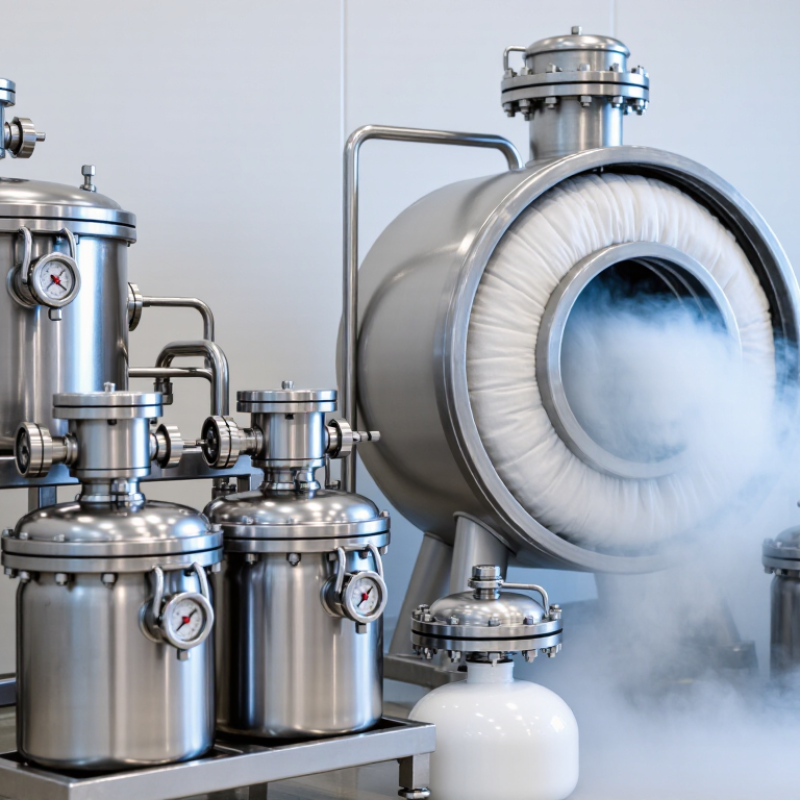
Choosing a cryogenic container starts with identifying the liquid and its operating pressure. Liquid nitrogen boils at about 77.4 K, or −195.8°C, at standard atmospheric pressure. The NIST Chemistry WebBook (Standard Reference Database 69) lists its normal boiling point at approximately 77.34 K. That difference is rounding, not a change in the cryogen. Boiling temperature shifts with pressure, so 77.4 K is a reference point rather than a universal operating condition.
NIST phase-change data also report nitrogen’s enthalpy of vaporization at roughly 5.6 kJ/mol near its boiling point. Heat entering through the vessel wall or neck drives evaporation, even when the container looks undisturbed. Small details matter. Compare insulation, neck opening, usable capacity, and stated evaporation rate against the required holding time and withdrawal pattern. A large capacity figure alone can mislead; test conditions affect the comparison.
Check that the vessel is designed for cryogenic service and has a suitable, unobstructed pressure-relief path. Never treat a storage vessel as a sealed container. During transfers, moisture can freeze around the neck, while repeated handling adds heat and increases losses. Review technical specifications for operating pressure and evaporation-rate test conditions. I would not rely on a single headline rating; real use rarely matches a perfectly controlled test.
Compare Capacity and Hold Time Using Manufacturer Evaporation-Rate Data
Capacity is only half the story when comparing cryogenic containers. Check the manufacturer’s evaporation-rate data alongside usable capacity. A larger vessel may still need more frequent refilling if it loses more liquid each day. That matters.
Compare rates in the same units, such as liters per day, and check the stated test conditions. Was the container stationary, properly sealed, and tested at a specified temperature? Small differences can make published figures hard to compare directly. Look closely.
For a rough estimate, divide usable liquid capacity by the daily evaporation rate. A container holding 20 liters with a stated loss of 0.2 liters per day suggests about 100 days under those test conditions. Treat that as a reference, not a promise. Opening the lid, moving the vessel, or adding warm material can increase losses. Real use is messier.
Think about your routine. If staff access the container several times each day, a longer theoretical hold time may not translate into fewer refills. Ask whether the data describes static storage or typical use, and leave a practical reserve rather than planning to the final liter. I would still compare the figures in a simple table; it is easy to overlook a unit mismatch. A careful check can prevent an inconvenient surprise.
Confirm Pressure Rating and Applicable Code, Such as ASME Section VIII
A cryogenic container’s pressure rating should match its intended service, not just the number shown in a catalog. Compare the maximum allowable working pressure with the expected operating pressure and temperature range. Cold service can affect material behavior, so confirm that the vessel’s documented rating applies at its design temperature. Check the plate.
Look for the applicable construction code, edition, and division in the nameplate and supporting documents. ASME Section VIII is commonly used for pressure vessels, but requirements can depend on the vessel type and location. Where required, verify the code marking and manufacturer’s data report with a qualified engineer or inspector. A stamp is useful evidence, not a substitute for reviewing the vessel’s actual design conditions.
Also check the pressure-relief device, its set pressure, and the maintenance records. The relief setting should be consistent with the vessel’s allowable pressure and the applicable code requirements. Ask how the container handles foreseeable pressure changes during filling, storage, and transfer. Details matter. A tidy specification sheet can still leave gaps, and I would not treat a quick visual check as enough. Confirm uncertain ratings before putting the container into service.
Check Static Vacuum-Insulation Compliance with ISO 21009
When selecting a static cryogenic container, check which part of ISO 21009 applies to its design and use.
The standard covers static vacuum-insulated vessels, with requirements addressing design, manufacture, inspection, testing, and operation. Confirm the supplier’s documentation identifies the applicable edition and vessel scope.
A certificate alone is not enough.
Ask for records that link the specific vessel to its design pressure, intended cryogenic service, inspection, and tests. Review vacuum-space construction and insulation data, then compare stated heat leak or hold time with your expected operating conditions. Look for clear test methods and acceptance criteria, not just a single performance number.
Details matter.
Also check what the documents say about inspection and maintenance after installation. Vacuum degradation may show up as faster product loss, frost in unexpected areas, or more frequent pressure relief events. These signs need qualified assessment, not guesswork.
Be cautious:
a compliant design does not guarantee identical performance in every site or duty cycle. Record ambient conditions, fill levels, and operating patterns when evaluating real-world results.
Review Venting and Relief: Liquid Nitrogen Expands About 694:1 as Gas
When choosing a cryogenic container, check its vent path and pressure-relief devices before comparing capacity or shape. NIST nitrogen property data support the familiar expansion figure: one volume of liquid nitrogen produces about 694 volumes of gas near ambient conditions. The exact ratio varies with temperature and pressure. That is not small.
A blocked vent can let vapor pressure rise quickly, even when the container looks intact. The Compressed Gas Association’s guidance on handling cryogenic liquids emphasizes suitable pressure relief and safe operating practices. Look for a design that keeps relief outlets unobstructed during normal use, transport, and storage. Do not plug a vent to reduce evaporation. A loose cap is not a relief system.
Check the rated relief pressure, expected boil-off, and container fill limits against the intended use. In a small room, released nitrogen can also displace oxygen; ventilation and oxygen monitoring may be needed after a risk assessment. Keep containers upright, leave clearance around outlets, and inspect for ice or damaged fittings. It is easy to focus on insulation and overlook the vent. That deserves a second look.
7 Tips for Choosing Cryogenic Containers - Review Venting and Relief: Liquid Nitrogen Expands About 694:1 as Gas
| Tip |
What to Check |
Relevant Fact |
Practical Selection Guidance |
| 1 |
Confirm the intended use |
Storage vessels, transport containers, and laboratory dewars can have different designs and operating limits. |
Choose a container specifically designed for the intended cryogenic liquid and use. Check its documentation for permitted applications and operating conditions. |
| 2 |
Review venting and pressure relief |
At approximately atmospheric pressure, liquid nitrogen expands about 694 times in volume when it vaporizes. The exact ratio depends on the reference conditions. |
Use a purpose-designed vented vessel or a vessel with an appropriate pressure-relief system. Never seal liquid nitrogen in a container that is not engineered for pressure. |
| 3 |
Check capacity and fill limits |
Cryogenic liquids can boil off as heat enters the container, and liquid expansion can create hazards if there is insufficient space. |
Match capacity to the expected quantity and handling needs. Follow the manufacturer’s fill limits and leave the required vapor space; do not overfill. |
| 4 |
Verify material compatibility |
Materials can become brittle at cryogenic temperatures, and thermal contraction can affect components and seals. |
Confirm that the vessel, fittings, valves, and accessories are rated for the specific cryogenic liquid and temperature range. Do not assume ordinary plastics or metals are suitable. |
| 5 |
Assess insulation and hold time |
Insulation reduces heat transfer, but no insulated vessel prevents heat from entering indefinitely; boil-off continues over time. |
Compare the stated static holding time and evaporation rate under the conditions relevant to your work. Allow for more frequent replenishment when opening or handling the vessel. |
| 6 |
Plan for ventilation and safe handling |
Nitrogen gas is colorless and odorless and can displace oxygen in enclosed or poorly ventilated spaces. |
Use and store containers in adequately ventilated areas. Consider the room layout and oxygen-deficiency risks, and follow site procedures for monitoring and emergency response. |
| 7 |
Inspect stability and condition |
Damage, blocked vents, or unstable placement can compromise safe operation and handling. |
Look for dents, corrosion, damaged insulation, loose fittings, and obstructed vents. Select a stable design suited to the route and handling method, and remove damaged equipment from service for evaluation. |
Use the container’s operating instructions and applicable workplace safety procedures; this checklist does not replace a formal risk assessment.