How to Choose the Best Cryogenic Refrigeration Systems for Your Needs?
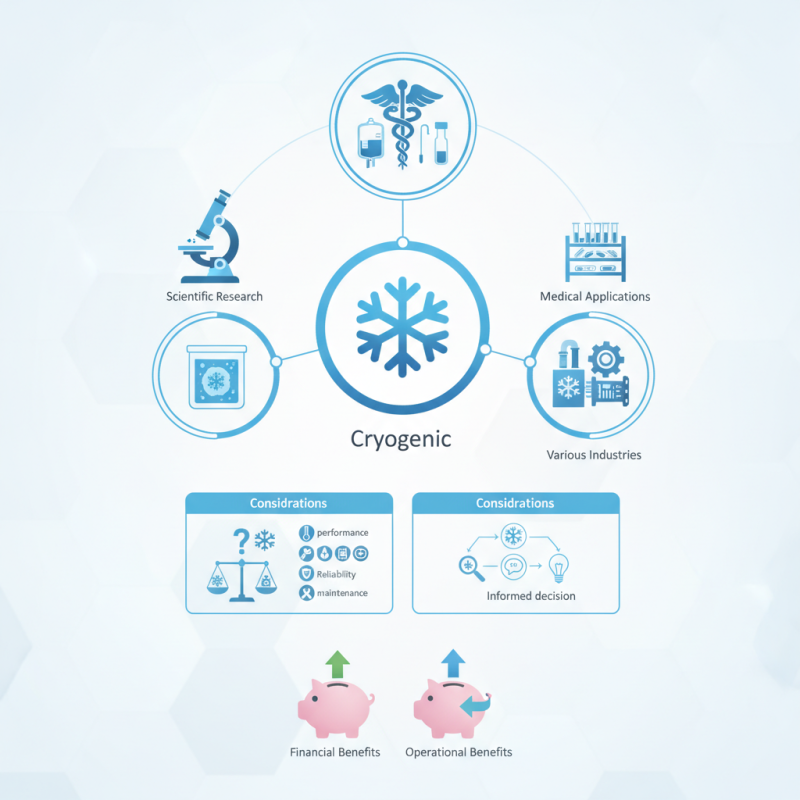
Choosing the right Cryogenic Refrigeration Systems is crucial for various industries. These systems play a vital role in preserving sensitive materials. From scientific research to medical applications, their importance cannot be overstated.
When exploring your options, consider your specific needs. Different systems offer various features and capacities. Not all Cryogenic Refrigeration Systems are suitable for every application. This can lead to inefficiencies or even equipment failure if the wrong choice is made.
Professional guidance is essential in this process. An expert can help you evaluate different systems. They can provide insights into performance, reliability, and maintenance. Research can be overwhelming, and it’s easy to overlook critical details. Making an informed decision can have long-term benefits, both financially and operationally.
Understanding Cryogenic Refrigeration Systems and Their Applications
Cryogenic refrigeration systems play a crucial role in various industries. They operate at ultra-low temperatures, typically below -150°C. Applications include medical, industrial, and research sectors. For example, liquefied gases like nitrogen and helium are essential in preserving biological samples. The demand for cryogenic systems is projected to grow by 8.4% annually, according to market research.
Understanding the applications is vital when selecting a system. In the medical field, cryogenic technology is used for tissue preservation and cryosurgery. In industrial settings, it's crucial for the production of superconducting materials. Research labs rely on these systems for experiments involving low temperatures. Thus, knowledge of your specific needs can greatly influence the choice of equipment.
However, users often underestimate the complexity of these systems. Maintenance can be challenging, requiring skilled technicians. Moreover, inefficiencies can lead to increased operational costs. Investing in a reliable system is crucial. Continuous performance evaluation is necessary for optimizing efficiency and longevity. Understanding both the benefits and potential pitfalls will lead to better decision-making.
Key Factors to Consider When Selecting a Cryogenic Refrigeration System
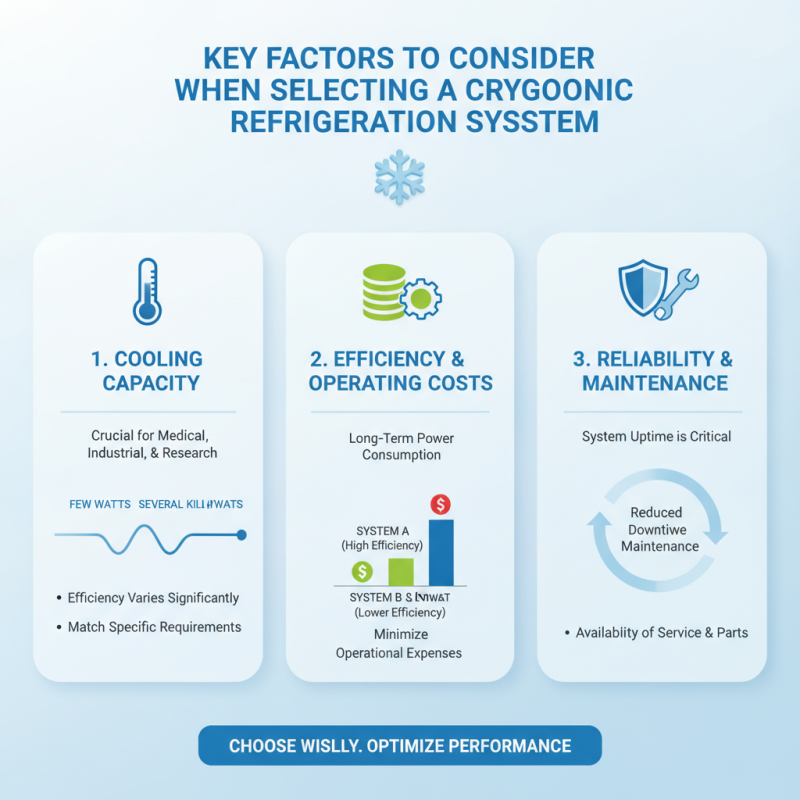
Selecting the right cryogenic refrigeration system is crucial for numerous applications, including medical, industrial, and research fields. One of the key factors to consider is the system's cooling capacity. Reports indicate that the efficiency of cryogenic systems can vary significantly. Systems typically range from a few watts to several kilowatts. Understanding your specific cooling requirements can help narrow down your options.
Another important aspect is the operational temperature range. Cryogenic systems usually function below -150°C. However, different applications may need varying temperature levels. For example, storing biological samples might require a system that maintains a steady -196°C. Inadequate temperature control can lead to sample degradation. Therefore, evaluating the temperature stability offered by different systems is essential.
Cost and maintenance should not be overlooked. It is reported that operating costs can accrue substantially over the years. A system requiring frequent repairs or high maintenance can quickly lead to budget overruns. Investing in reliable technology may save money long-term. However, the initial outlay can sometimes be a barrier. Balancing budget constraints with system performance is a common dilemma that many users face.
Comparing Different Types of Cryogenic Refrigeration Technologies
When choosing a cryogenic refrigeration system, it's essential to understand the various technologies available. Two dominant types are Joule-Thomson and Stirling cycles. The Joule-Thomson effect is used in gas liquefaction. It's efficient for certain gases, but not all perform well under its principles. Universally, the efficiency of these systems can vary widely. Reports indicate that the efficiency rates can fluctuate between 40% to 70%, depending on system design and operating conditions. Understanding these nuances is critical.
Stirling engines, on the other hand, are known for their reliability and compactness. They operate on a cyclic process that can achieve ultra-low temperatures. Data suggests that modern Stirling systems often reach temperatures below -253°C. However, they may require more maintenance due to moving parts and complexity. Users often overlook the importance of maintenance cycles, which can impact overall efficiency.
**Tips:**
When evaluating systems, consider your specific application needs and environment. Research operational costs thoroughly. Efficient systems may reduce energy consumption but require higher initial investments. Engaging with professionals for a tailored analysis can yield better long-term benefits. Be aware that some technologies are evolving. Staying informed ensures you're not left behind in a rapidly advancing field.
Comparing Different Types of Cryogenic Refrigeration Technologies
This chart compares the performance of various types of cryogenic refrigeration systems. Liquid nitrogen systems exhibit the highest performance, followed by helium refrigeration systems. Closed-cycle systems and dilution refrigerators show relatively lower performance levels.
Evaluating System Efficiency and Cost-Effectiveness
When choosing cryogenic refrigeration systems, evaluating efficiency and cost-effectiveness is critical. Cryogenic systems often operate at very low temperatures, impacting both energy consumption and overall costs. According to a recent industry report, the average efficiency of modern cryogenic systems has improved, achieving up to 30% better energy utilization compared to older models.
Understanding energy efficiency is essential. The coefficient of performance (COP) is a primary metric for assessing system efficiency. A higher COP means more cooling output per energy unit consumed. In practice, systems with a COP of 1.5 to 2 are considered efficient. However, factors such as ambient temperature and system design can influence performance. Regular maintenance is equally important, as neglect can lead to efficiency drops of 10% or more over time.
Cost-effectiveness goes beyond initial investment. A lifecycle cost analysis is necessary to consider operation, maintenance, and energy expenditures. One study found that poorly maintained systems could result in energy costs that exceed the initial purchase price in three to five years. Thus, selecting a cryogenic refrigeration system involves careful consideration of both efficiency metrics and long-term financial implications. Balancing these aspects can lead to better decision-making in meeting specific refrigeration needs.
How to Choose the Best Cryogenic Refrigeration Systems for Your Needs?
| System Type |
Cooling Capacity (kW) |
Efficiency (COP) |
Operating Cost ($/hour) |
Initial Cost ($) |
| Cryocooler A |
15 |
2.8 |
5.00 |
3000 |
| Cryocooler B |
20 |
3.2 |
6.00 |
4000 |
| Cryostat C |
10 |
2.5 |
4.50 |
2000 |
| Cryogenic System D |
25 |
3.5 |
7.00 |
5000 |
Maintenance and Support for Cryogenic Refrigeration Systems
When selecting cryogenic refrigeration systems, maintenance and support play crucial roles. Regular maintenance ensures optimal performance and longevity. Without it, issues can arise, leading to costly repairs. Routine checks include inspecting refrigerant levels and electrical connections. Timely maintenance prevents breakdowns and keeps operations running smoothly.
Supporting systems also offers value. Technicians trained in cryogenics can identify problems early. They provide expert recommendations based on specific applications. However, not all support services are equal. Some may lack experience in unique and complex systems. This can lead to misdiagnoses and unsatisfactory solutions.
Choosing a reliable support system is vital. Look for providers with a solid track record. They should demonstrate expertise in the cryogenic field. Seek client testimonials and case studies to evaluate their competency. A strong relationship with service providers ensures assistance is just a call away.