




New Breakthrough Achieved in Independent Innovation of Superconducting Cyclotron at China Institute of Atomic Energy
Recently, the China Institute of Atomic Energy has made new breakthroughs in the field of fully self-developed superconducting cyclotron innovation and has gradually established a high-quality intellectual property portfolio.
The invention patent titled “Method for Obtaining Strong Focusing of Isochronous Accelerator by Varying Magnetic Field Gradient in Large Radial Range” has been granted authorization in the United States. Another invention patent, “Cyclotron Capable of Accelerating Alpha Particles and H₂⁺ Particles, High-Gain Method and High-Precision Method with the Same,” has been granted authorization by the European Patent Office and has taken effect in 18 European countries, including Belgium, Germany, France, Italy, the Netherlands, and Sweden.
These patented achievements have laid a solid foundation for the innovative development and industrial application of compact high-power high-temperature superconducting isochronous accelerators, as well as multi-particle, multi-purpose superconducting cyclotrons.
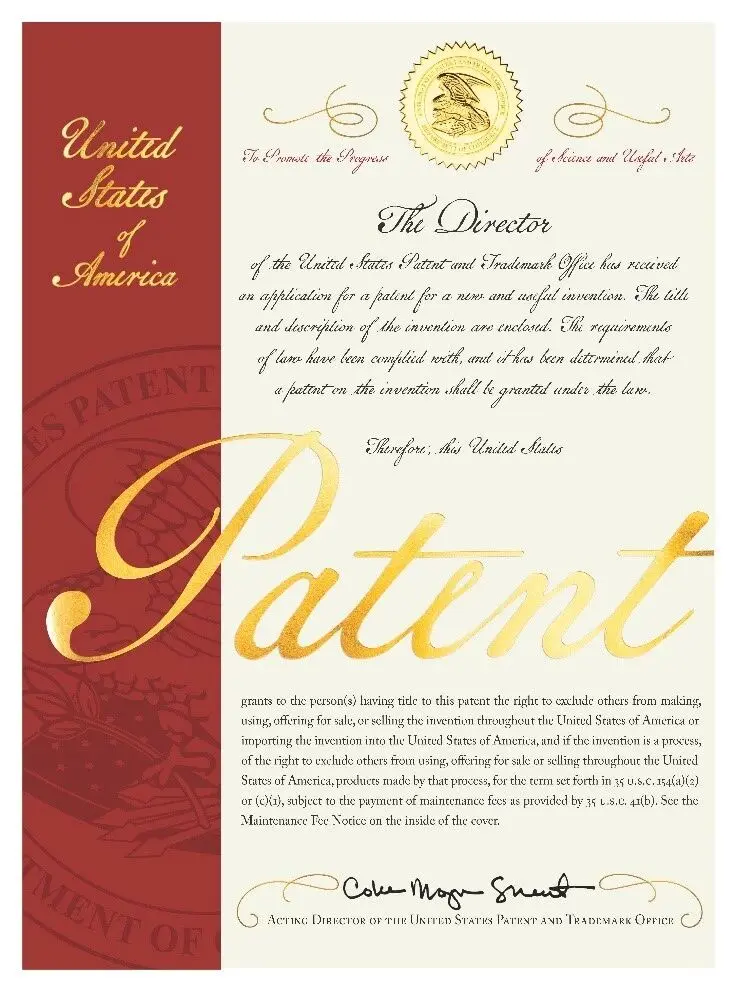
U.S. Authorized Patent Certificate
The invention patent “Method for Obtaining Strong Focusing of Isochronous Accelerator by Varying Magnetic Field Gradient in Large Radial Range” innovatively proposes modulating multiple orders of the main magnetic field gradient across a large radial range to generate equivalent multipole fields at specific local radial positions. This approach resolves key physical challenges, including precise modulation of high-order gradients along particle orbits and the strong coupling between isochronism and focusing strength. It provides a core theoretical foundation for the development of high-energy, high-power high-temperature superconducting cyclotrons.
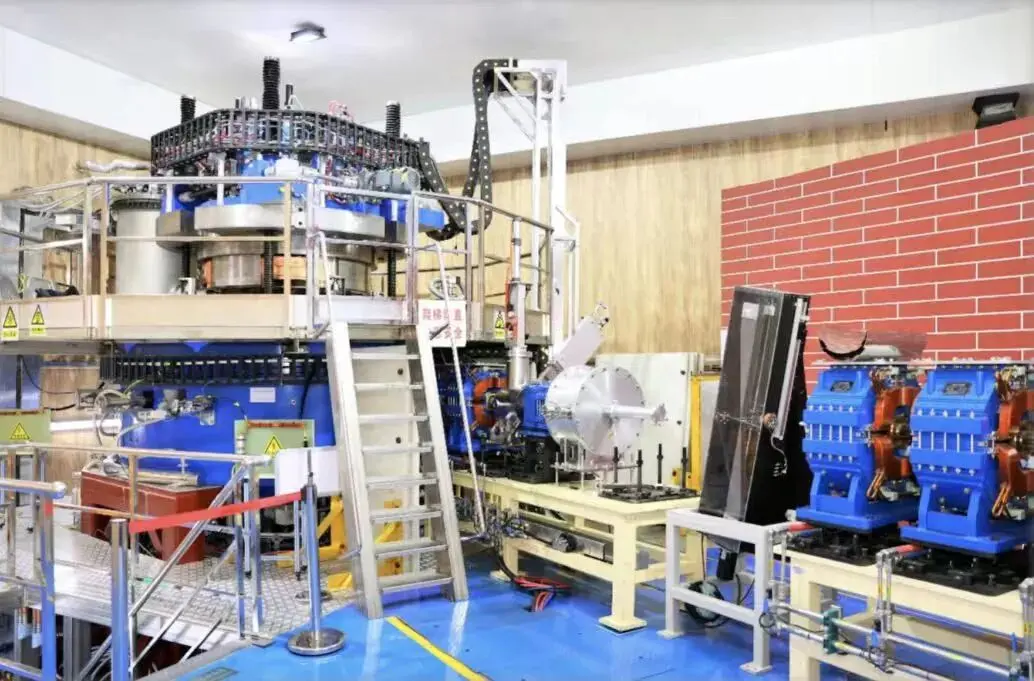
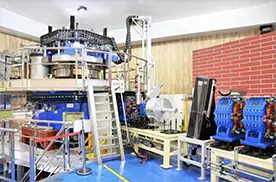
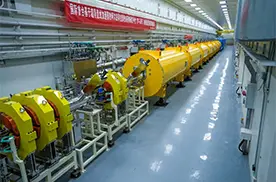
230 MeV Superconducting Cyclotron and Beamline
The invention patent “Cyclotron Capable of Accelerating Alpha Particles and H₂⁺ Particles, High-Gain Method and High-Precision Method with the Same” proposes, for the first time, a high-gain and high-precision method enabling dual-beam injection and acceleration of alpha particles and H₂⁺ particles. This breakthrough aims to achieve high beam current performance in superconducting cyclotrons and has supported the approval of a national major scientific instrument project.
Recently, another technological innovation of the Institute’s superconducting cyclotron has achieved new progress. The independently designed and developed 230 MeV superconducting cyclotron and beamline application terminal was tested by experts. Results show that the extracted proton beam energy reached 243.3 MeV, with an acceleration–extraction efficiency of 83.9%. Both the stable beam current supply and the maximum achievable beam intensity exceed those of comparable international equipment within the same energy range, reaching ultra-high dose rates.
The energy adjustment range of the application terminal is 20 MeV to 242 MeV, and the dose uniformity within a 30 mm × 30 mm irradiation field is better than 90%.