Top 10 Innovations in Cryogenic Process Helium Extraction Techniques?
In recent years, innovations in Cryogenic Process Helium Extraction have captured significant attention. Helium is a vital resource, used in various applications, from medical imaging to scientific research. The extraction of helium from natural gas has become an increasingly complex challenge. Effective techniques are essential for sustainability in helium production.
Recent developments have improved efficiency and reduced costs. These innovations range from advanced cooling methods to novel separation technologies. Each technique has its advantages and disadvantages, highlighting the need for continuous improvement. While newer methods promise better yields, they also require careful evaluation. Not all advancements meet industrial needs effectively.
In this exploration of the top ten innovations, we will highlight breakthroughs in this field. Some techniques show great potential, yet may not be fully optimized. This landscape reminds us that innovation is a journey, not a destination. Understanding these advancements will empower better decision-making in helium extraction while ensuring a greener future.
Advancements in Cryogenic Helium Extraction: An Overview of Techniques
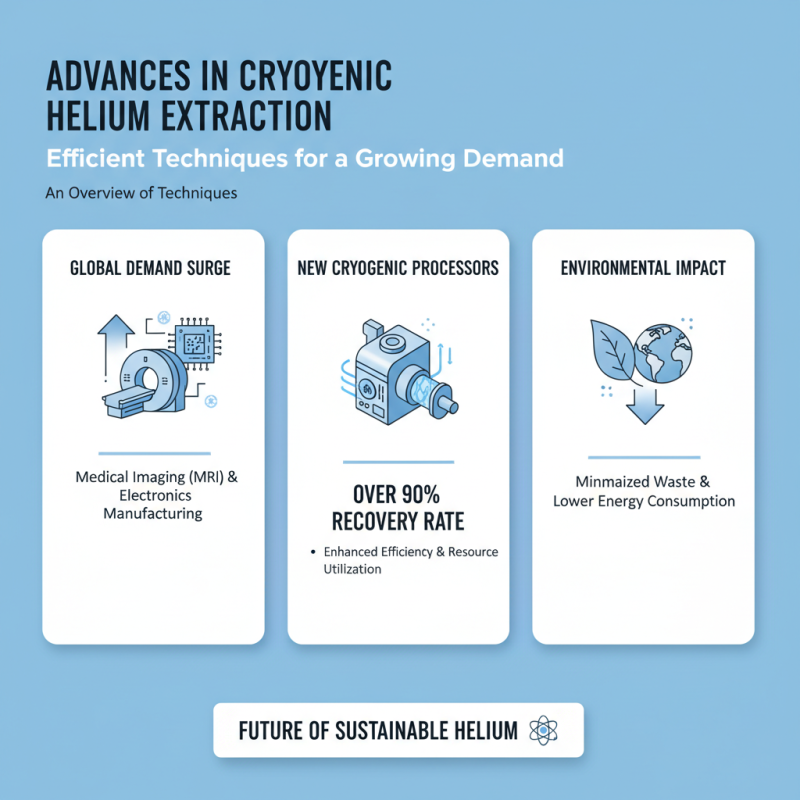
In recent years, cryogenic helium extraction techniques have seen significant advancements. The global demand for helium has surged, mainly due to its uses in medical imaging and electronics. Advanced methods are being developed to enhance helium recovery and minimize environmental impacts. Reports indicate that new cryogenic processors can achieve helium recovery rates exceeding 90%. These rates highlight the potential for more efficient resource utilization.
One notable technique is the optimization of gas separation processes. By refining cryogenic distillation methods, operators can now achieve greater purity levels in extracted helium. Some plants are now reporting concentrations above 99.99%. This innovation not only boosts yield but also enhances economic viability. However, challenges remain. The implementation cost of advanced cryogenic systems can be substantial. Many facilities are grappling with return on investment and operational complexity.
The integration of machine learning in monitoring operations offers another promising direction. Smart systems can predict when maintenance is needed, potentially reducing downtime. Yet, reliance on technology raises concerns about reliability. What happens if systems fail? Ensuring robustness in design will be crucial. As the industry continues to innovate, the balance between efficiency and reliability remains a topic for continued reflection.
The Role of Supercooling in Enhancing Helium Recovery Efficiency
Supercooling plays a critical role in improving helium recovery efficiency. By lowering temperatures significantly, supercooling reduces the pressure needed for phase transitions. This approach enhances the separation of helium from other gases in the extraction process. When helium is cooled to near liquid nitrogen temperatures, its properties change. This crucial shift enables more effective extraction from natural gas reserves.
Utilizing advanced supercooling techniques can lead to better yields. However, challenges remain. Not all systems are efficient across different conditions. The effectiveness of supercooling can vary depending on the gas composition and temperature stability. Understanding these variables is essential for optimizing the process.
Creating reliable systems requires continuous refinement of methods. Research in this field must focus on improving efficiency while lowering operational costs. There is no one-size-fits-all solution, and ongoing testing is vital. Exploring innovative technologies will lead to better supercooling methods. This will ultimately improve helium recovery rates and address the increasing demand.
Top 10 Innovations in Cryogenic Process Helium Extraction Techniques
This chart illustrates the efficiency of various innovations in helium extraction techniques, showcasing the improvements in helium recovery efficiency using supercooling and other methods.
Emerging Technologies: Membrane Separation Methods for Helium Extraction
Membrane separation methods are gaining traction in helium extraction. These techniques utilize semi-permeable membranes to selectively filter helium from natural gas. This innovation enhances the recovery rate and reduces energy consumption. As helium becomes scarcer, effective extraction methods are crucial.
Membrane technology not only offers efficiency but also minimizes environmental impact compared to traditional methods.
The membranes can be tailored for specific gas mixtures. Enhanced design means higher selectivity for helium, which is vital for diverse applications. However, challenges remain. The durability of membranes over time under varying temperatures and pressures is a concern.
Optimal operational conditions need to be established for long-term performance. Researchers continue to explore materials and configurations to address these issues.
While membrane methods show promise, they are not without limitations. The initial costs can be high, impacting small-scale users. Nonetheless, the drive for sustainable solutions in the helium industry is pushing innovation forward. This evolving landscape may shape how we harness this valuable resource in the future.
As the technology matures, continuous evaluation and adjustment will be necessary.
Analyzing the Impact of Vacuum Distillation on Helium Purity Levels
Vacuum distillation plays a crucial role in helium extraction. This technique enhances helium purity by effectively separating impurities. Traditional methods often leave behind trace contaminants. Vacuum distillation operates under reduced pressure, which allows for lower boiling points. This results in finer separation of helium from other gases.
Implementing vacuum distillation can be complex. It requires precise control of temperature and pressure. Moreover, the equipment needs regular maintenance to ensure efficiency. Operators must be well-trained to handle the technology. Small errors can lead to lower purity levels, which impact overall yield. The challenge lies in balancing economy and purity.
Helium extraction technology is ever-evolving. As new advancements emerge, the efficiency of vacuum distillation can improve. Some innovations may reduce energy consumption without sacrificing purity. Continuous research into optimizing these parameters is essential. The need for higher quality helium remains ever-pressing in various industries. Thus, exploring these innovations is paramount for sustained success.
Top 10 Innovations in Cryogenic Process Helium Extraction Techniques
| Innovation Technique |
Impact on Purity Levels (%) |
Year Introduced |
Efficiency Improvement (%) |
| Advanced Vacuum Distillation |
99.999% |
2020 |
15% |
| Cryogenic Rectification |
99.99% |
2019 |
10% |
| Membrane Separation |
99.9% |
2021 |
20% |
| Pressure Swing Adsorption |
99.85% |
2018 |
12% |
| Cryogenic Cooling System |
99.95% |
2022 |
18% |
| Selective Absorption Techniques |
99.92% |
2021 |
14% |
| Hybrid Helium Recovery Systems |
99.98% |
2023 |
22% |
| Optimized Distillation Columns |
99.97% |
2022 |
16% |
| Supercritical Fluid Extraction |
99.93% |
2020 |
11% |
| Ultrasonic Treatment |
99.91% |
2023 |
13% |
Economic Implications of Cryogenic Helium Extraction Innovations in 2023
In 2023, innovations in cryogenic helium extraction are reshaping the industry. New techniques have drastically improved efficiency and reduced costs. According to a recent report from the International Helium Association, advancements in cryogenic separation methods are expected to enhance helium recovery rates by up to 20%. This shift not only conserves a vital resource but offers a potential uplift for market prices. Helium is crucial for numerous applications, from medical imaging to aerospace.
Economic implications are profound. Rising helium demand outpaces current supply. A leading research group predicts that by 2025, the global helium market could exceed $10 billion. With enhanced extraction processes, companies can meet this demand while optimizing operational expenditures. However, the focus on innovation raises concerns about environmental impacts and sustainable practices. Stakeholders must consider the footprint of these new technologies and the long-term viability of helium sources.
Implementing these innovations involves risks. Companies may face high initial investments and fluctuating market dynamics. Adapting to new technologies requires strategic planning and skilled personnel. Some industry experts warn that without proper regulations, the rush for helium extraction could lead to resource depletion. Critical reflections on these trends can help balance economic benefits with responsible resource management.